Showing posts with label Self Sufficiency Region. Show all posts

Renewable Energy Regions and Municipalities, Germany

Keywords: renewable energy region, 100% renewable energy self sufficiency region, Germany, renewable energy self sufficiency region in Germany.


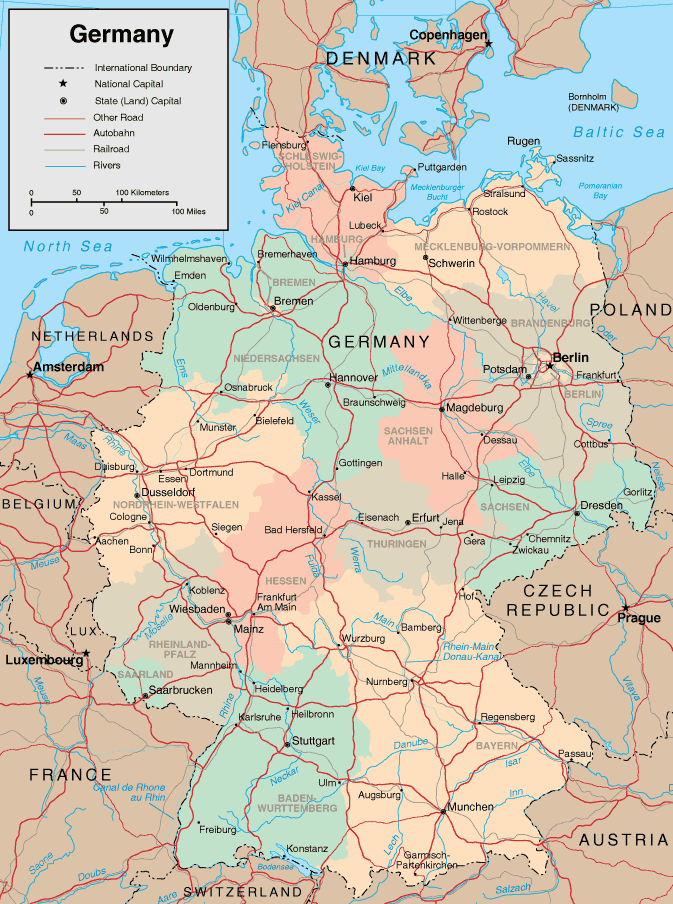
Federal republic of Germany is a country in Central Europe (Figure 1). It is bordered by (Figure 2):[1]
  • North: North Sea, Denmark, and Baltic Sea
  • East: Poland, Czech Republic
  • South: Austria, Switzerland
  • West: France,Luxembourg, Belgium, Netherland

Figure 1. Germany in Central Europe[1]


Figure 2. Border of Germany[2]

The territory of Germany is about 357,021 km2 and is influenced by temperate seasonal climate. It is the largest population among the member states of the European Union and home to the third-largest number of international migrants worldwide.[1]


Renewable Energy Development
Since 1997, Germany and the other states of the European Union have been working towards a target of 12% renewable energy electricity in 2010. That target has been achieved in 2007 when the share reached 14%. The share of renewable energy has increased from 6.3% in 2000 to 15% in 2008.1 The German government increased the target for renewable energy to 27% by 2020 and at least 45% by 2030.[3]


Renewable Energy Regions and Municipalities
There are two institution published the list of 100% renewable energy regions and municipalities in Germany. They are deENet Kassel University and International Solar Energy Association, German Section (Deutsche Gesellschaft für Sonnenenergie e.V.).

100% Renewable Energy Regions
The University of Kassel and the non-profit society for the promotion of decentralized energy technology(deENet) conducted joint project "Prospect for development of sustainable 100% renewable energy regions in Germany" documented, analyzed, and rated regional activities in full supply with renewable energy and supported regional actors on the conversion of energy supply. There are 82 of 100% renewable energy regions and local authorities were interviewed. This interview utilized 54 questionnaires as the basis data for the following presented results. Some of those substantial results are:[4]
  • 80% of regions in Germany have taken such political decision or they have planning to switch the energy to renewable. In many regions, political decision represents an important milestones on the way to 100% renewable energy. What is the role and the important of political decisions in the process of energy conversion and which advantages and disadvantages may be associated with it for each arrangement of decision, are still needed to be analyzed.
  • Distribution of renewable energy regions last year has a high dynamic growing. During 2005-2008 the number of decision to be 100% renewable energy regions increased up to 6 decisions per year (averagely).
  • Conflicts and political difference are not the first barriers in the development of objective concepts and decisions, but coordination or procurement of funds.
  • The main motives for the conversion of energy supply on renewable energy are to increase regional added value, independence from fossil fuels, to contribute in sustainable regional development. One motive which is less significant but still important is to achieve climate change objectives.
  • Most regions start with conversion of energy supply to renewable energy. Almost half of the region interviewed were busy with concept development and planning or communication and public relations. These are not exclusive, but at least it is the tendency at the beginning of the implementation process.
  • It is moderately important for the conversion of the energy system on renewable energy for most regions to have their own municipal utilities and also own electricity and gas network.
In the analysis, definition of 100% renewable energy regions used were:[4]
  • regions who were first taken decision, in the next decade those regions have been sustainable and completely converted the energy to renewable; electricity, heat, and mobility only from renewable energy. This particularly includes the widest reduction of energy consumption through conservation and efficient use of energy. The energy should be environmental and health friendly. The energy should be from local sources and it boosts the local economy. The implementation of an energy conversion has wide support from regional actors and the development objectives in the minds of the region citizens are anchored.
  • regions who have have carried out implementation activities, measures, and programs to realize sustainable energy system; at least in the form of action concepts.
  • regions who on the state level have reached milestones on the path to sustainable renewable-energy region and have approached their goal already.
The change on energy in some regions are still in the beginning, therefore not all the criteria fulfilled by the region. The concrete classification of 100% renewable energy regions in this project are the regional objectives, activities, achievement., target and action level. Only regions which have sufficient data will be included in the list of 100% renewable energy regions.4

There are 34 renewable energy regions and 10 renewable energy local authorities represented in the map.
Another 46 communities are not represented as sub-regions within the represented regions. The total area of the map recorded in 100% renewable energy regions occupies 10% of Germany, 6.9% of the German population (5.7 million inhabitants) live in these regions. The 100% renewable energy regions are distributed all over Germany, with some accumulation is observed in southern Bavaria. In Saarland and Thuringia have been no 100% renewable energy region identified. List of 100% renewable energy regions and municipalities in Germany can be viewed in Table 1 - 3.[4]

Table 1. 100% Regions in Germany[4]

Table 2. 100% Municipalities in Germany[4]

Table 3. 100% Municipalities and Regions inside Renewable Energy Regions[4]


Energy Map
In 2009, there was a site launched by International Solar Energy Association, German Section (Deutsche Gesellschaft für Sonnenenergie e.V.). This site publised renewable energy states, cities, and districts in Germany. In the publication, they justified that in fact they did not know which regions have achieved 100% self sufficiency, the map will show how close regions are with 100% self sufficiency.[5]

Data input used come from EEG reports and E.ON. In the presenting data, there are problems encountered with the data quality of the EEG reports, many systems are currently still associated with the wrong community. Especially in the Transpower-Area (E.ON), where only postal codes are published, a detailed regional allocation is not possible. Therefore, there are extreme distortion in many areas. Also hydro-power is not included into EEG reports, this results there is no hydro-power to be accounted in this list.[5]

The states, cities, and districts are ranked into top ten based on rate of self sufficiency. Besides, inside the region there are municipalities and cities which have achieved also 100% self sufficiency. The date used is always renewed every year, due to that reason number chosen is the new one (28.03.2010). Top ten cities and districts can be viewed in Table 4.[5]

Table 4. Top Ten Cities and Districts in Germany[5]

Except 100% renewable energy regions, energy map also provides renewable energy regions which the rate below 100%. Details and type of renewable energy implemented are also available. In general, almost all regions in Germany are renewable energy regions, whatever is the rate of self-sufficient.[5]


Main Success Factors
Success factor of renewable energy development in Germany is due to "Renewable Energy Act" implementation and Feed-in electricity tariffs. Renewable energy act states that people who produce energy in their own homes can sell their 'product' at fixed prices for a period of 20 years.[6] Feed-in tariffs supports the development of renewable energy. In 2005, 10% electricity came from renewable energy, 70% of them was supported by feed-in tariffs.[7] The policy also set for people to buy energy generated from renewable resources first before buying from non-renewable resources.[6]


Ongoing Experiment "How Germany Can Power itself by Renewable Energy
Regarding the future target and the possibility to gain it, scientist from Kassel University gave a brief description how Germany can power itself entirely by renewable energy. In an ongoing experiment 'Combined Power Plant', they link 36 biogas plants, wind, solar and hydro power installation in a distributed network (Figure 2).[8]


Figure 2. Fully Renewable[8]

The test project is scaled to meet 1/10,000th of the electricity demand in Germany. This scale corresponds to the annual electricity requirements of a small town with around 12,000 households. Projections show Germany has enough domestic resources to scale up production of renewable and replace all fossil fuels and nuclear power (Figure 3). The scientist argued Germany can achieve full renewable based energy autonomy by mid of century.[8]

Figure 3. Combined Power Plant[8]


Information Related


List of References
  1. Germany. http://en.wikipedia.org/wiki/Germany. Accessed September 26, 2009.
  2. Map of Germany. http://www.map-of-germany.org/map-of-germany.gif. Accessed 17, 2010.
  3. Germany Leads Way on Renewable, Sets 45% Target by 2030. http://www.worldwatch.org/node/5430. Accessed March 23, 2010.
  4. Schriftliche Befragung von Erneuerbare-Energie-Regionen in Deutschland: Regionale Ziele, Aktivitäten und Einschätzungen in Bezug auf 100% Erneuerbare Energie in Regionen. http://www.100-ee-kongress.de/fileadmin/content/Vortragsunterlagen/Arbeitsmaterialien_100EE_Nr1_web.pdf. Accessed September 27, 2009.
  5. EnergyMap: Die Karte der Erneuerbare Energien. http://www.energymap.info/index.html. Accessed March 28, 2010.
  6. Renewable Energy in Germany. http://en.wikipedia.org/wiki/Renewable_energy_in_Germany. Accessed October 10, 2009.
  7. Feed-in Tariffs in Germany. http://en.wikipedia.org/wiki/Feed-in_tariffs_in_Germany. Accessed March 24, 2010.
  8. Germany Going 100% Renewable (Or Yet Another Reason Why America is Falling Behind). http://www.blog.thesietch.org/2007/12/30/germany-going-100-renewable-or-yet-another-reason-why-america-is-falling-behind/. Accessed March 23, 2010.

Sustainable Energy Zone, Japan

Keywords: renewable energy region, 100% renewable energy self sufficiency region, Sustainable Zone.


Sustainable energy zone is a phrase invented by a Chiba University research group leader Prof. Hidefumi Kurasaka. It refers to a zone where all energy requirements can be met by renewable (natural energy) created within that zone. In this case, renewable energy refers to photovoltaic (solar), wind, geothermal, biomass, and small scale hydro. The ratio of supply in respect to demand is supply rate.[1]

Rate (available supply) = (amount of power generated by renewable natural energy in the area) / (energy demand for the people in the area)[2]

If the supply rate is more than 100%, the area is classified as sustainable energy zone. Currently when the criteria is limited to electricity only, there are 76 municipalities in Japan classified as sustainable energy zones as July 2007 (Table 1).[2]


Table 1. Top / 100% list of persistent energy zone[2]

Table 1. Top / 100% list of persistent energy zone (continue)[2]

Table 1. Top / 100% list of persistent energy zone (continue)[2]
The extremely high supply rates over 3000% of the two top two zones, Yanaizu in Fukushima and Kokone in Oita, are because of large scale geothermal generators built in the zone. However, overall 70% of the zones have small-scale hydroelectric plants (in stream units under 10 MW).[1]


Yanaizu Town, Kawanuma County District, Fukushima Prefectures
Geothermal power plants are pretty common in Japan by reason of volcanic activity. Japan ranks the sixth in the terms of global geothermal electricity capacity. Totally, there are 18 major geothermal power stations in operation (Figure 1), but their aggregate output only accounts around 0.2 - 0.3% of generated electricity. In the earlier of 2009, Mitsubishi Materials Corp., J-Power, Nittetsu Mining Co. Ltd., and Kyushu Power Co. will build new geothermal power plants with government support. The development is starting in 2009. Today, Japan produces 535.2 MW (GHC Bulletin).[3]

Figure 1. Geothermal power plants in Japan[4]

Yanaizu Town, Kawanuma County District, Fukushima Prefecture is located in rural area which is far away from the big cities in Japan. This town became popular after Prof. Hidefumi Kurasaka announced his list of Japan's most self-sufficient places and placed the town in the top of the list. Yanaizu ranks in the first due to its fantastic rate of geothermal energy generating at 3290% (Figure 2). The second place is achieved by Kokone Town Kusu in Oita Prefecture with rate 3123%. They also use geothermal as main power to supply their energy requirement.[3]

Figure 2. Welcoming poster in Geothermal power station in Japan[3]


Kochi Prefecture
Hydroelectric power is Japan's largest energy resource.[5] Overall, 70% of the zones have small-scale hydroelectric plants (in stream units under 10 MW).[1] Kochi Prefecture in the Shikoku Island has rivers, plentiful forests, and mountains which bring abundance of rain.[5] Takaoka-cho, Tsuno-gun and Taiho-cho Nagaoka-gun are two cities in Kochi Prefecture which use hydro (renewable energy) as the main power in producing electricity to supply energy demand required.[2]

Actually in the beginning, the people found that it took some effort. But after town meetings (Figure 3), they like the idea of self sufficiency and environmental benefits. Other reasons are, linking energy education with issues such as global warming and the need to reduce CO2 emission have a lot of sense to be considered.[5]

Figure 3. Micro hydro power in Japan[5]

The micro-hydro project is meant to create energy independence while also protecting local industry in the forestry and agricultural sectors. These projects are "small is beautiful". It is a kind of deal based on community desire "don't want to have huge dams or more concrete, just a clever way to produce energy (Figure 4)".[5]

Figure 4. Modern hydro-power plant based on an ancient design[3]

On account of that, the design is adapted to the request of small scale hydroelectric power plant. One company which provide small scale hydroelectric power plants in Japan is Toshiba's Hydro-eKIDS. Their design[6] (Figure 5) is also used by other community in northwest of Edinburgh, Scotland.[5]

Figure 5. Design features of hydro power plant[7]


Energy self sufficiency in Hokkaido
Other regions which has more 100%percentage self sufficient is located in Hokkaido Island (Table 2). The type of renewable energy used are wind and solar power. Nowadays, there will be some additional construction of RE plants in Hokkaido. They are mega solar power station 5000 kW (Figure 6) and wind power station 258 million kW (Table 3). Cape Erimo in Hokkaido has annual average wind speed 8.2 m/sec or 30 km/h (Figure 7). Wind power in Horonobe Town can be viewed in Figure 8.[8]

Table 2. High self sufficiency regions in Hokkaido[8]


Figure 6. Mega solar power station 5000 kW (now under construction)[8]


Table 3. The amount of wind power in Hokkaido (recently constructed)[8]


Figure 7. Annual average wind speed in Cape Erimo, Hokkaido Island[8]


Figure 8. Wind power station at Honorobe Town[8]

When considering as a whole, Japan's renewable energy is only 3.35%. Only 10 prefectures in Japan have rate above 10%. One of them is Oita Prefecture with the highest rate of supply at 30.8%.[1]


Notion of Sustainable energy zones - Problems
First problem is scale. Sustainable energy zones look at individual municipality, but when considering prefectures as a whole, the highest rate is Oita Prefecture at 30.8%, with only 9 prefectures in total above 10%. As a whole, Japan's renewable energy supply rate is only 3.35%. Therefore, the amazing supply rate, 3290% is only possible when looking at individual municipalities.[1]

The second problem is the relationship between the supply rate and actual measures taken by the municipalities. In many cases, the high supply rate is not a result of energy measures taken by the municipalities, but rather than an outside power company has chosen that site for development. Therefore having a high supply rate does not necessarily mean the area has advance electricity measures in place, and there is no point labeling a municipality good or bad based solely on this figure.[1]

The important thing is not only to say "wow" some places have such an abundance of renewable energy, but consider how this energy can be used to create a sustainable society. This will give new importance to these numbers and what they indicate.[1]


List of References:
  1. 3290% Energy Self-Sufficient! Sustainable Energy Zones in Our Back Yard. http://greenz.jp/en/2009/09/11/sustanable_zone/. Accessed September 25, 2009.
  2. Sustainable Zone Official Homepage. http://sustainable-zone.org. Accessed October 12, 2009.
  3. The First 3290% Energy Self-Sufficient Town in Japan. http://www.treehugger.com/files/2009/09/geothermal-japan.php. Accessed September 25, 2009.
  4. Volcanic Zones of Japan. http://wwwsoc.nii.ac.jp/grsj/geothermalinJ/Res&PP/volcan_zone/main121c.html. Accessed October 28, 2009.
  5. Micro-Hydro Power Picking Up Spead as more Rural Towns Want to go Off-Grid. http://www.treehugger.com/files/2009/07/micro-hydro-power-japan.php. Accessed October 28, 2009.
  6. Hydro-eKIDS. http://www.tic.toshiba.com.au/hydro-ekids__8482_/. Accessed October 28, 2009.
  7. Design Features. http://www.tic.toshiba.com.au/design_features/. Accessed October 28, 2009.
  8. The possibility of food and energy self-sufficiency in Hokkaido. http://www.adm.u-tokyo.ac.jp/res/res5/PPT/4-4%20Nobuyuki%20Tsuji.pdf. Accessed August 23, 2009.

Varese Ligure, Liguria, Italy

Keywords: renewable energy region, 100% renewable energy self sufficiency region, Varese Ligure, renewable energy in Varese Ligure.


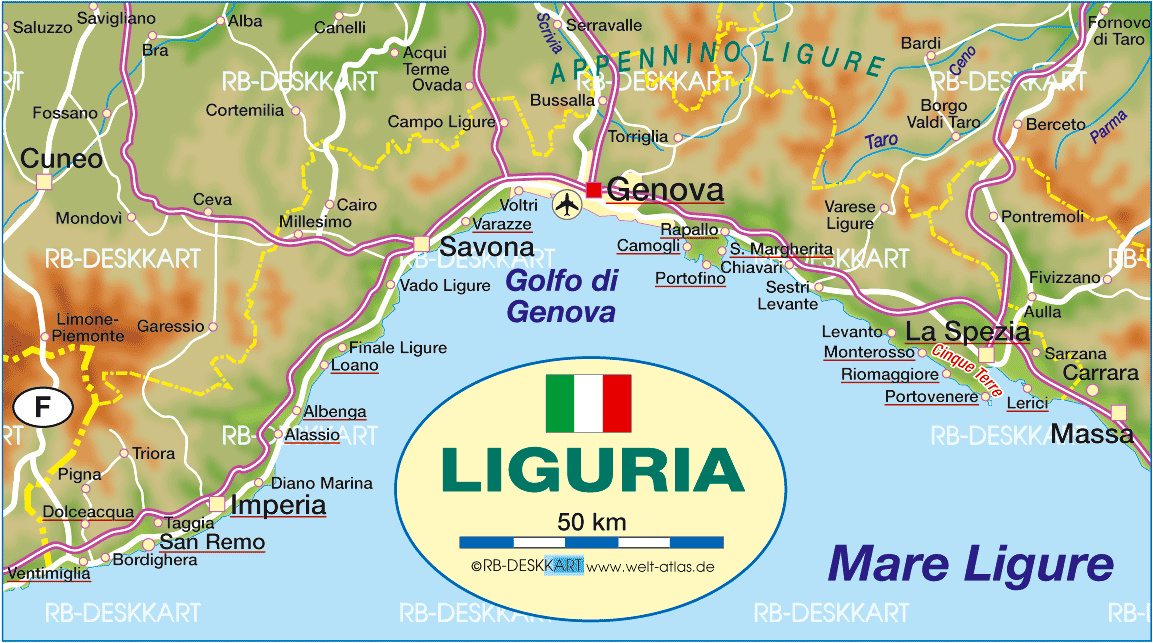
Varese Ligure is a municipality in the Italian Region Liguria. Politically, the region is apart of La Spezia province.[1] It is a small rural village which 95% of the land of the rural local authority has not been built and covered by forests.[2] The region is located in the northernmost of the province (Figure 1) and bordered by Genua Province and Parma Province (Emilia-Romagna). The area of Varese is around 136 km2 and occupied by 2,176 inhabitants (2009). The population density is around 16 inhabitants/km2. The community is called "Comunità Montana dell’Alta Val di Vera".[1]

Figure 1. Varese Ligure[3][4][5]


Renewable Energy Development
Background
A decade ago, Varese Ligure found itself in difficulties due to a weakening economy, decaying settlements and people moving away. This prompted the mayor to try to reverse the trend by investing in its main resources within the framework of sustainable development.[2][7]

Target
The target of Varese Ligure is to become 100% renewable and 100% organic.[2][7]

Status
The local authority of Varese Ligure is close to its target.[2] Varese became the first municipality in Europe to get 100% of its power from renewable energy sources in 2001. The region now generates three times more electricity than the people living in Varese need.[6]


Organization of Procurement
A comprehensive program of sustainable development was put in place to achieve self-sufficiency through the promotion of renewable energy sources and energy efficiency. The strategy is managed by the City Council under the direct supervision of its mayor, who is supported, as far as the environmental certification aspects are concerned (periodical audits), by an ad hoc committee.[2]


Measures
The measures to promote and raise awareness in term of renewable energy development were:[2]
  • Promotion of renewable energy sources: the focus is on wind (two wind-power generators with a capacity of 2 millions kWh/year installed and other 2 generators will soon be installed), solar (two photovoltaic plants installed and a third installation on the public wastewater treatment station is scheduled) and biomass technologies.
  • Promotion of energy efficiency: the focus is on biomass; the authorities are promoting the use of pellet boilers by encouraging local production of pellets as a means of generating income and contributing to forestry maintenance.
  • Awareness-raising: one of the main actions is the participation in the EU project for schools called FEE (Force Energetique par les Enfantes), to raise the awareness of pupils, families and local stakeholders on energy issues (energy saving and renewable sources) and to the environment in general.


Development Strategy
The village launched its overall development strategy with the renovation of the urban centre; on the economic side. The policy has focused on promoting agriculture and tourism and encouraging farmers to take up organic farming. The administration protect and promote the environmental quality of the village. An important aspect of the environmental strategy is the focus on renewable energy sources and energy saving. All these actions have resulted in important synergies that support each other to reach the target.[7]

Varese 100% Sustainable
The town has launched some initiatives to make Varese 100% sustainable:[6]
  • a total of 108 organic farms supply 98% of the town’s food;
  • water is purified using environmentally friendly technology;
  • waste has been significantly reduced.


Renewable Energy in Varese Ligure
Varese Ligure uses a mix of wind, solar, and small-scale hydropower.[6] The local authority is now completely self-sustainable as far as electricity is concerned. The establishment of wind and PV plants reduce CO2 emission approximately 9.600 kg/year.[2]

Wind Power
There are four wind turbines generator in Varese Ligure.[6] Two wind-power generators produce 4 million kWh/year. Other two wind-power generators produce 2 million kWh/year.[2][6] Totally 8 million kWh/year of electricity is produced and fed into the local grid managed by Acam, a power company in La Spezia. The wind turbines are located on a ridge 1100 meters above sea level.[6]

Figure 2. Wind Turbines Generator in Varese Ligure: a)[8] b)[6]

Photovoltaic (PV)
The town hall has 102 PV panels covering 95 m2 and generating 12,700 kWh/year,[6] which supplies 98% of the total energy consumption of the building. Varese’s secondary school has 39 PV panels covering 36 m2 and producing 4,600 kWh/year,[2][6] which supplies 62% of the energy used.[6]

Solar Power
In Varese Ligure, the town’s swimming pool is heated by solar power.[6]

Wood Pellet Stoves
A program to promote the utilization of wood pellet stoves is in the works.[6]


Finances
The wind farm with a total of 1.800,00 € was financed by EU and regional funds (30%) as well as by private investments (60%). The PV installation with a total of 155.000 € was funded by regional and local funds.[2]


Benefits of Renewable Energy Development
There are some benefits gained through the sustainable development in Varese Ligure:[6]
  • The energy network through added jobs, and an additional 350,000 euros [US $514,000] in revenues which are handed over to the council each year.
  • Varese has a six-fold increase in tourists in the last ten years (up to 2007). Many of them are coming just to see its renewable energy network.


Achievements[2][7]
  • In October 1999: Varese Ligure become the first ISO 14001 certified Italian local authority.
  • In November 1999: the first European EMAS-registered local authority.
  • In January 2004: “Best rural EU-local authority for the promotion of renewable energy” at the European conference on RES in Berlin.


Information Related


List of References
  1. Varese Ligure. http://de.wikipedia.org/wiki/Varese_Ligure. Accessed April 14th, 2010.
  2. Case Study: Varese Ligure towards 100% Renewable. http://www.procuraplus.org/fileadmin/template/projects/procuraplus/files/CD-ROM/Case_Studies/Electricity_Varese_Ligure_Italy_01.pdf. Accessed January 05, 2010.
  3. Carta. http://www.agricella.com/immagini/carta.jpg. Accessed May 31, 2010.
  4. Karte. http://www.welt-atlas.de/datenbank/karten/karte-1-233.gif. Accessed May 31, 2010.
  5. Italy Map. http://www.pure-adventures.com/book-a-hotel/images/italy-map.gif. Accessed May 31, 2010.
  6. Italian Town Runs On 100% Renewable Power. http://www.metaefficient.com/renewable-power/italian-town-runs-on-100-renewable-power.html. Accessed April 14, 2010.
  7. Varese Ligure 100% Sustainable. http://ec.europa.eu/energy/idae_site/deploy/prj083/prj083_1.html. Accessed April 14, 2010.
  8. Varese Ligure towards 100% Renewable - Photo Sharing. http://www.flickr.com/photos/pepesec/3257569275/in/set-72157613435032700/. Accessed April 14, 2010.

Isle of Eigg, Scotland

Keywords: renewable energy region, 100% renewable energy self sufficiency region, Isle of Eigg, renewable energy in Isle of Eigg.


The island of Eigg is a small island in Scotland.[1] It locates in the south of the Skye and to the north of Ardnamurchan peninsula. This island is 9 km long from north to south, and 5 km from east to west. The area is 31 km2[2] and the population in 2009 is over 80 people.[3]

Figure 1. Location of Eigg in United Kingdom[3]


Current Status
Eigg is the World's first self sufficiency island.[1] Isle of Eigg is a model of energy self sufficient island, because all electricity made locally (Figure 2). The inhabitants have managed to generate all the energy consumed which combines solar energy, wind energy (Figure 3), and hydro power.[1]

Figure 2. Residents of the Isle of Eigg utilize renewable energy sources[3]


Figure 3. Wind Turbines in Eigg[3]

Before the development of renewable energy, electric service was spotty. Residents mostly relied on noisy, expensive diesel generators or mini-hydroelectric generators. But since February 1, Eigg has switched on its own continuous, clean, and renewable energy supply. Now, the islanders enjoy luxuries of modern living that mainlanders take for granted.[3]


Self-Supply System
The self-supply system is built to generate 95% energy that the island needs. The system is equipped with a storage battery system and two diesel generators in case of emergency. It took 10 years to finish the project which was completed on February 2009. 45 houses are connected to the system, 6 buildings and 20 shops along 10 miles are covered by the system (Figure 4). The houses have access to 5 kW and the business 10 kW. 5 kW is less than half of energy of a house in the United States has access to[1] and one-half to two-thirds of the amount used by a household in Britain. Islander can add the electricity ration with a diesel generator or heat from a wood stove. If the islanders use too much electricity and trip up the system, they will have to pay £20 ($40) to be switched on again. All of these conditions were agreed to by the residents.[3]

Figure 4. Houses in Issle of Eigg, Scotland[1]


Project Starting Point
The project starting point has a correlation with the history of the island. For centuries, the entire island has been owned by a series single landowners. It means, the residents only could rental without having opportunity to own the island. The residents only could survive. In 1996, the exasperated islanders teamed up to buy the island for themselves. Donation are collected from across Britain up to Detroit. June 1997, the islanders took ownership of Eigg. In the following years, they built a new jetty, renovated the village hall, school, shop, tearoom (Figure 5), and the last was created the new electrical grid[4] after the commissioned of feasibility studies in 2006.[3]

Figure 5. Tearoom: Residents gather at the island’s tearoom to wait for the ferry, and parcels from the mainland[3]


Development of the System
There are many parties involved from starting point of the development of renewable energy up to Eigg became energy self sufficiency island. Started from islanders, investors, Eigg Electric, and the Island of Eigg Heritage Trust.[4]

The Island of Eigg Heritage Trust
It is a a company limited by guarantee, and a registered Scottish charity. The Trust has three members, Eigg Residents' Association, The Highland Council and The Scottish Wildlife Trust. Each of these members appoints directors to the board of the Trust. On 12th June 2007, they celebrated 10 years of ownership.[5] The electrification in Eigg began after members of the Island of Eigg Heritage Trust commissioned feasibility studies on the best way of connecting islanders to one main power grid.[3]

Eigg Electricity Ltd.
Eigg Electricity Ltd. is one of subsidiary companies of the Isle of Eigg Heritage Trust.[5] This company, during the development of electrification from renewable energy, appointed a project manager and partnered with an electrical company from the mainland. Eigg Electric co-director, John Booth (Figure 6) led the push of self sufficiency. John Booth is a retired industrial relations consultant from England who moved to the island in 2000 with his wife to renovate an old house. When the idea for the project was executed, he made himself as a full-time volunteer. No one knew if the grid would really work. Booth said, "We did our homework, and when we came up against something we didn't know, we went back to the physics books."[4]

Figure 6. John Booth, beside one of the island's photovoltaic panels[2][3]


Project Cost and Fair Pricing System
Overall budget have been spent was more than $8 million dollars. $3.2 million dollars was raised from investors. This fund come from many sources, including the European Union Regional Development Fund, Britain's National Lottery, the Scottish government, and also local and regional government programs.[4]

This system is expensive due to they had to tap the mainland's power grid through an underwater cable. In fact, none of them islanders, said it is too expensive and a waste of taxpayers' money. The islanders prefer to generate electricity from renewable than nuclear power.[4]

According to Booth, the benefits of Eigg's green power outweigh the cost. Renewable energy doesn't risk becoming much more expensive, unlike the diesel fuel used to power the old generators. Islanders also say their pricing system is fairer. The system has a much more social aspect. Everybody is allocated the same amount of electricity, so everybody pays the same. That way everyone benefits.[4]


Information Related


List of References
  1. Eigg, The World's First Self Sufficient Island. http://www.gstriatum.com/solarenergy/2009/03/eigg-the-worlds-first-self-sufficient-island/. Accessed August 23, 2009.
  2. Eigg. http://en.wikipedia.org/wiki/Eigg. Accessed April 3, 2010.
  3. Isle of Eigg a Model of Energy Self-Sufficiency - On the Scenic Island of Scotland, All Electricity is Made Locally. http://www.csmonitor.com/Environment/2008/0327/p13s01-sten.html. Accessed April 3, 2010.
  4. Isle of Eigg a Model of Energy Self-Sufficiency - On the Scenic Island of Scotland, All Electricity is Made Locally (Page 2 of 2). http://www.csmonitor.com/Environment/2008/0327/p13s01-sten.html/%28page%29/2. Accessed April 3, 2010.
  5. The Isle of Eigg Official Homepage. http://www.isleofeigg.net/welcome/welcome_frame2.htm. Accessed April 3, 2010.

Samsø, Denmark

Keywords: renewable energy region, 100% renewable energy self sufficiency region, Samsoe, renewable energy in Samsø.


Samsø is a Danish island[1] located in the North Sea bay of Kattegat (Figure 1), between the mainland of Jutland and the island of Zealand,[2] 15 km from the Jutland Peninsula.[1] Samsø is a small island and community.[2] The community is called "Samsingers". The total area is around 114 km2 and the population is about 4,300 inhabitants (2009).[1] Its main activities include farming, tourism, and - lately - renewable energy.[2]

Figure 1. Samsø Island in Denmark[3][4]


Background of Renewable Energy Development
In the Danish Action Plan, Energy 21 1996, it was decided that the government should work on the designation of a local area which should change its supply of energy to local RE sources. As a result of this commitment, the government held a competition to become a model of renewable energy community.[5] Engineer Ole Johnsson, from the mainland town of Aarhus, became fascinated by the competition and saw Samso as the ideal place to realize this energy self-sufficiency dream. After studying the island's annual wind-speed and sunshine-hour records, he calculated how much energy the island could produce from wind turbines and other alternative sources and concluded it was possible to beat conventional sources. He sent the plan (Figure 2) to Copenhagen and it won.[6] In November 1997,[7] Samsø was chosen among five competing islands, to be powered and fuelled by renewable energy only - including the transport sector- within the next decade. Being chosen as a renewable Energy Island does not mean that the energy agency/Government decides and pays everything. Without the contribution of the population, there will be no RE island.[5]


Status
In 1997, this island was entirely dependent on oil and coal which were imported from the mainland.[1] Since 2003, Samsø has been self-sufficient in energy.[8] Now, Samsø has achieved 140% self-sufficiency of renewable energy.[9] 11 onshore wind turbines are able to fulfill 100% the island's electricity demand.[7][8][9] 70% of their heating demand[7][9][10] is obtained from solar power and biomass.[1][7] The rest is gained through imported petroleum, which is compensated by 10 offshore wind turbines.[7][9]


Renewable Energy Island Project
Renewable energy island is an individual project, but during 1998-2002 it was also a part of the EC's ALTENER program that encouraged the development and expansion of an already-viable market for renewable energy sources. Subsidies were received from ALTENER program. The most important means to achieve were:[2]
  • Cuts in consumption and increased efficiency in terms of heat, electricity and transport by the introduction of up to date energy technologies and adjusting people´s behavior patterns.
  • Expansion of the district heating supply systems combined with utilization of local bio-mass resources.
  • Expansion of individual heating systems using heat pumps, solar heating, biomass-plants and other means.
  • Construction of land-based and offshore wind power plants to cover electricity production.
  • Gradual conversion of the transport sector from petrol and oil power to electrical power, and later on hydrogen.

Aim
The aim of the RE island project was to convert all of Samsø’s energy supply to 100% renewable energy within 10 years.[2]

Objective
Danish Energy Agency selected Samsoe to become “Renewable Energy Island” with the purpose over few years to demonstrate that an integrated energy planning based on renewable energy source could be implemented within a limited geographic area.[10]

Target
The target set for project Samsø Renewable Energy Island was a 100% share of renewable energy in ten years.[8]


Program
Focus of the Program
  • Starting point: the program started in 1997, when Samsø won a renewable-energy contest, sponsored by the Danish Ministry of Environment and Energy, and was named “Denmark’s Renewable Energy Island”.[2]
  • First condition: Samsø received basically no benefits from the government: no prize money, no tax breaks, and not even government assistance. Then some government money was found to fund a single staff position in the program. Søren Hermansen became the first employee and he tried to get the program really going.[2]
  • The start: the Samsingers were conservative and hesitating, and waited for the neighbors to do the first move. Hermansen participated the local meetings and brought up the renewable energy project. At the same time he tried to get the support of the island’s opinion leaders.[2]
  • The energy plan: the project used a rough timetable that was included in the energy plan made by PlanEnergi. It is an independent consultancy firm specializing in renewable energy, environment, sustainable systems, energy planning and technology transfer. The original master plan included detailed plans and calculations. These plans changed along the way, when local residents took part in the planning processes.[2]
  • Budget: at first, financial resources came primarily from Danish Energy Agency, Århus Regional Authority and Samsø Municipality. But most of the investments of the project have come from local residents.[2]
  • Target group: all the residents of Samsø island. The project tried to reach the Samsingers in many roles as citizens, consumers, household owners and property owners.[2]

Design of the Program
  • Knowledge and ideas informed the design of the program: the project was based on a vision that the project should be approached by a bottom-up method by creating citizen involvement right from the start. It was a rather loosely organized project, where the ideas and methods evolved along the way.[2]
  • Research conducted on target group: the project was based on strong local grass-root knowledge of the people and conditions in Samsø.[2]
  • Project initiator: the aim was to get the support of the island’s opinion leaders. When more and more people got involved and were active, that prompted others to follow.[2]
  • Campaigns: to give knowledge and practical abilities to save energy and get acquainted with renewable energy technology. It included education and certification of local entrepreneurs, house calls by energy advisors, and energy saving campaigns.[2]
  • Design of the project: the program was designed so that the target group would also have other benefits than energy savings as a result of their behavioral change. It also relied on the social benefits that it would create when the Samsingers would work together to contribute to renewable island project.[2]
  • The intervention: started after Samsø had won the national renewable energy competition.[2]
  • Methods to get people involved in the project (participation): invited citizens to participate in work groups for the planning and development work, involved in choosing the technologies to be used in the project, (later) made financial investments to these technologies.[2] The main purpose of this method was to create local people’s “ownership” of the developed solutions.[10]
  • Social pressure: the project aimed to use social pressure generated by a small community to promote the program, and succeeded in that.[2]
  • Communication plan: local media have been used extensively to inform about and mobilize participation in different activities, and to give status reports about the progress of the project. Information about the project was also presented in the numerous meetings during the project.[2]

Process of the Program
  • Interaction between the different participants: a large network of different actors evolved to support the project; RE island project personnel, private citizens of Samsø, Samsø municipality, Danish Government, and local and external business.[2]
  • Reaction of the project manager to issues/problems: if the original plan encountered problems, they usually tried to solve it another way. If the original plan didn’t work at all, they abandoned it.[2]
  • Feedback system: there wasn’t really a system of feedback in the project. The participation to these projects was voluntary, so perhaps it could be seen as a form of feedback, if people didn’t take part.[2]


Progress
  • 1997: Samsø Energy- and Environmental Agency was established.[2][10]
  • 1998: Samsø Energy Company was established.[2][10]
  • 2000: 11 onshore wind turbines were erected in three areas across the island.[8]
  • 2003: 10 offshore wind turbines were operated in the south of Samsø.[8]
  • 2004: the fourth new heating plants based on renewable sources was opened and 6 villages were supplied with district heating based on renewable sources.[10]
  • 2005: reached a 100% renewable electricity and 70% renewable heating.[10]
  • 2007: Samsø Energy Academy was opened.[10]


Renewable Energy in Samsø Island
21 Wind Turbines
The 21 wind turbines are divided in two different application, onshore and offshore. 11 onshore wind turbines (Figure 2) has a total height of 77 m and located in three areas across the island.[8] Each turbine has a power of 1 MW and generates electricity for 630 standard households.[8][9] All together 11 turbines produce electricity more than the island's total consumption of electricity. The turbines are connected to the electricity grid in Jutland via transformer stations in the city of Vadstrup. They transmit electricity when there are excess of electricity production. The total electricity production of 11 wind turbines in average is around 28,000 MWh/year. 10 offshore wind turbines (Figure 3) are located in the south of Samsø.[8] Each of them has a power more than 2 MW.[11] It is used to offset the CO2 footprint of the transportation sector of the island, including the ferries.[9]

Figure 2. Onshore wind turbines[11]

Onshore wind turbines:[9]
  • Tanderup: three turbines, the annual production is around 7,600 MWh.
  • Permelile: three turbines, the annual production is around 7,600 MWh.
  • Brundby: five turbines, the production is around 12,700 MW/year.
Offshore wind turbines: the annual production is around 77,500 MWh (280 TJ).[9]

Figure 3. Offshore wind turbines[9]

Four District Heating Plants
  • The district heating plant in Nordby/Mårup: receives heat from 2500 m2 solar panels (Figure 4) and a 900 kW wood chip-fired boiler (Figure 5). The plant is the only heating plant of its kind based on solar panels and a wood chip-fired boiler.[8]
Figure 4. Solar Heat[12]

Figure 5. Wood Fires[13]
  • Tranebjerg district heating: the plant was established in 1993 and was the first district heating plant on Samsø. A total of 263 private homes, commercial enterprises, housing associations and institutions are connected to the district heating network. The straw boiler in the plant has an output of 3MW and the total heating consumption is around 9,500MWh/year.[8]
  • Ballen/Brundby district heating: the plant fires straw (Figure 6) and is the only which is 100% owned by its users. It supplies 232 consumers in Ballen and Brundby and is located between these two towns. A group of inhabitants from the two towns and Samsø energy company jointly own the district heating plant.[8]
Figure 6. Søren Hermansen in front of the Stacks of half-ton Hay Bales [14]
  • The district heating plant in Onsbjerg: is a straw-fired district heating plant with 76 households and institutions connected. It is a local private limited company.[8]

Privately owned Plants for Geothermal Heating, Solar Heating, and Pellet Boilers
An estimated 300 households in Samsø’s have invested in renewable heating systems. Some have had solar panels installed on their roof (Figure 7) which provide hot water and serve as supplementary heating. Others have replaced their old oil boiler with a pellet boiler, a masonry stove or another biomass-fired boiler. Finally, some have had the still more popular heat pumps installed, either for geothermal heating or in the form of an air-to-air heat pump.[8]

Figure 7. Solar on the Roof[9]


Samsø Energy Academy
Samsø Energy Academy (Figure 8) officially opened in May 2007[8] in Ballen.[1] The building is equipped with south-facing solar panels.[17] The functions are:
  • It is a community hall for energy concerns, a meeting place for energy and local development.[2]
  • The Energy Academy houses the renewable energy organizations of Samsø Energy Agency, Energy Service Denmark and Samsø Energy and Environment office.[2]
  • It also provides RE education and communication by mediating workshops, conferences and exhibitions.[2][8][10]
  • It is a basis for research.
  • It gives service of renewable energy[8][10] such as gives advice to Samsø islanders on insulation (Figure 9) and replacement of oil boilers.[8]

Figure 8. The Energy Academy[15]

Figure 9. Insulation of the Samsø's House[16]

Samsø Energy- and Environmental Agency
It was established to promote the Renewable Energy Island project and to counsel the citizens who wanted to establish their own renewable energy projects. The partners were Danish Energy Agency, Århus Regional Authority, Samsø Municipality, Samsø Business Forum, Samsø Farmers Association and Danish Ministry of Energy.[2]

Samsø Energy Company
It was founded to be responsible for the overall coordinating of many different energy supply projects;[10] and to implement Renewable Energy projects, especially wind turbine and district heating projects. Together with Samsø Energy- and Environmental Office they organized campaigns and meetings.[2]

Hydrogen Experiment
The Energy Academy is running an experiment (Figure 10) to turn wind electricity produced at night, when prices are low, into hydrogen via an electrolyzer (in the shed here) to be turned back into electricity, when prices are higher. It is a stored supply to fully when Samsø off of electricity produced by burning fossil fuels elsewhere in Denmark.[17]

Figure 10. Experiment on Hydrogen[17]


Finance of the Project
Total finance for the project were 53.3 million EUR investments and 4.0 million EUR public subsidies. The project also gained economic savings and profits to those who participated.[10]

Financial Resources and Partners
[10]
  • Financial resources: Danish Energy Agency, Aarhus Regional Authority, Samsø Municipality, Samsø Energy- and Environmental Agency.
  • Other partners: Samsø Business Forum, Samsø Farmer's Association, Samsø Energy Company, Danish Ministry of Energy.
  • Samsø Energy Academy.

Investment Share of the Project[8]
  • 11 onshore wind turbines: total investment was DKK 66 million. Nine of the wind turbines are owned by local farmers. The remaining are owned by a local wind turbine association. These turbines are divided into about 5,400 shares, owned by 450 people.
  • 10 offshore wind turbines: the municipality of Samsø has invested DKK 25 million in the procurement of the five offshore wind turbines.
  • Ballen/Brundby district heating: the Danish Energy Agency has provided a DKK 2.5-million subsidy for construction of the plant.
  • Samsø Energy Academy: profits from electricity production of the five offshore wind turbines owned by Samsø municipality have led to a subsidy of DKK 5 million.


Lesson Learned
A main lesson learned is the bottom-up approach with citizens’ involvement in any step right from the beginning. One evident example is the implementing of new land based windmills, where often end up with the protest like “not in my back yard” from private land owners. Here the initiative to a new windmill came from local involved land owners – and one of first things were to make a written agreement allowing the windmill to be located here – before further planning continued. And then again local people were involved later on in managing and operating the energy plants.[10]

Success and Failure of the Project
Overall, the renewable energy island project was almost completely successful, because it fulfilled most of the goals that were set.[2]

Success of the Project were:[2]
  • 100% self-sufficiency with renewable energy using local resources has been achieved in 8 years, two years ahead of time.
  • Three new district heating plants were built, 70% of the total heat production is now produced by renewable energy.
  • New wind turbines were established: 10 offshore and 11 onshore.
Failures of the Project were:[2]
  • Heat consumption aimed at 25% reduction, but instead ended up with 10% increase.
  • Savings in electricity consumption aimed at 15% reduction, but achieved only 3-4%.
  • The transportation sector aimed to reduce the energy consumption of transportation by 5-10%, but instead it increased by 5%.
  • The behavioral changes were not successful. The achievements in energy savings and conservation were minimal, despite of the several campaigns aimed to reduce the energy consumption.
The reasons of failure for savings in electricity usage and heating are:[2]
  • It might be a consequences of the success in other field. When people get better insulation, they heat their home as much as used, and get a warmer home.
  • The trend to build larger houses increases heat consumption.
  • When people save money in using local electricity and heating sources, they buy more electric appliances that use energy.
  • It could be that people felt that they deserved a “reward” after all the hard work they did for the project.
  • It could also be that the positive social dynamics that worked in favor of building RE production units did not work in the field of energy savings.

Success and Failure Factors
Internal factors:[10]
  • Bottom-up approach in any steps from creating ideas and planning to implementing and operating.
  • Land-owner written agreements regarding possible location of energy plants/installations etc.
  • Creating of local citizens’ ownership of project initiatives as well as of final solutions.
External factors:[10]
  • Commitment from local, regional and national energy authorities.
  • Experiences and expertise available from energy authorities and research institutions.
  • Funding support.
The most crucial factors influenced the project's success:[2]
  • The economic benefits of the program: It has brought investments, more tourism to island, and thus generated jobs; The residents are shareholders in the wind turbines and are gaining profits from it; The price of heating energy has decreased after the early investments have paid off.
  • Local participation: the islanders have participated in the project in many levels.
  • Use of existing networks and organizations: the project was based on networks and communities that already existed.
  • No free riders: many or all were taking apart.

Keys of Success
Søren Hermansen, the Director of the Samsø Energy Academy, gave a view of the keys success of any significant renewable energy project are community involvement and local ownership.[18]

Social Learning
The project results were communicated both to the local populace and the world at large. The success of the project can also be seen in growing interest of renewable energy tourism. Some of the changes brought by the RE island project have been sustainable and durable. Even though the project has achieved its main goals, the renewable energy is going to be an important element in Samsø.[2]


Information Related


List of References
  1. Samsoe. http://en.wikipedia.org/wiki/Sams%C3%B8. Accessed May 07, 2010.
  2. Case Study 18: Samsø - Renewable Energy Island Program, Denmark. http://www.energychange.info/downloads/doc_download/337-cbcase18denmarksamsoe. Accessed May 07, 2010.
  3. Denmark. http://www.worldportsource.com/images/maps/denmark_sm00.jpg. Accessed May 28, 2010.
  4. Samsoe. http://www.shetland-news.co.uk/2010/April/news/Samso.jpg. Accessed May 28, 2010.
  5. Renewable Energy Island - The Danish Energy Way. http://old.insula.org/islandsonline/REI%20-%20The%20Danish%20Way-1.pdf. Assessed November 21, 2009.
  6. Samso: the Energy Self-sufficient Island. http://www.ngpowereu.com/news/samso-energy-self-sufficient/. Accessed January 06, 2010.
  7. Case: Samsoe Renewable Energy Island. http://www.denmark.dk/en/menu/Climate-Energy/Fact-Sheets/Where-Does-Your-Energy-Come-From/CaseSamsoeRenewableEnergyIsland.htm. Accessed May 07, 2010.
  8. Samsø Renewable Energy Island - Goal: 100% Renewable Energy in 10 Years. http://www.ens.dk/en-US/Info/news/Factsheet/Documents/samsoe170709.pdf%20engelsk.pdf. Accessed May 07, 2010.
  9. The 140% Renewable Energy Island of Samsø. http://www.appropedia.org/Sams%C3%B8_renewable_energy. Accessed May 07, 2010.
  10. Renewable Energy Island - Samsoe Energy Agency, Denmark. http://www.musecenergy.eu/web/practices/denmark/02_Renewable_energy_island.pdf. Accessed 21, 2009.
  11. 100% Renewable? One Danish Island Experiments with Clean Power: Inherit the Wind. http://www.scientificamerican.com/slideshow.cfm?id=samso-attempts-100-percent-renewable-power&photo_id=34114448-D86C-8038-F30949C718BDC04C. Accessed May 28, 2010.
  12. 100% Renewable? One Danish Island Experiments with Clean Power: Solar Heat. http://www.scientificamerican.com/slideshow.cfm?id=samso-attempts-100-percent-renewable-power&photo_id=34114462-E1CB-3C0C-8923F3A83D5CB084. Accessed May 28, 2010.
  13. 100% Renewable? One Danish Island Experiments with Clean Power: Wood Fires. http://www.scientificamerican.com/slideshow.cfm?id=samso-attempts-100-percent-renewable-power&photo_id=3411445E-E659-FA22-94F94A28947A5867. Accessed May 28, 2010.
  14. 100% Renewable? One Danish Island Experiments with Clean Power: Straw Heat. http://www.scientificamerican.com/slideshow.cfm?id=samso-attempts-100-percent-renewable-power&photo_id=34114453-CF30-4953-EC246B8F0CCCDC77. Accessed May 28, 2010.
  15. 100% Renewable? One Danish Island Experiments with Clean Power: Energy Academy. http://www.scientificamerican.com/slideshow.cfm?id=samso-attempts-100-percent-renewable-power&photo_id=34114443-B153-6A88-BC3C624EC4F2CD78. Accessed May 28, 2010.
  16. 100% Renewable? One Danish Island Experiments with Clean Power: Insulation. http://www.scientificamerican.com/slideshow.cfm?id=samso-attempts-100-percent-renewable-power&photo_id=34114466-EE67-C439-1D4EFCF4E9428D26. Accessed May 28, 2010.
  17. 100% Renewable? One Danish Island Experiments with Clean Power: Hydrogen Hope. http://www.scientificamerican.com/slideshow.cfm?id=samso-attempts-100-percent-renewable-power&photo_id=3411446B-088C-9ABE-656D05148A0489F8. Accessed May 28, 2010.
  18. Local Ownership is the Key. http://www.shetland-news.co.uk/2010/April/news/Local%20ownership%20is%20the%20key.htm. Accessed May 28, 2010.